

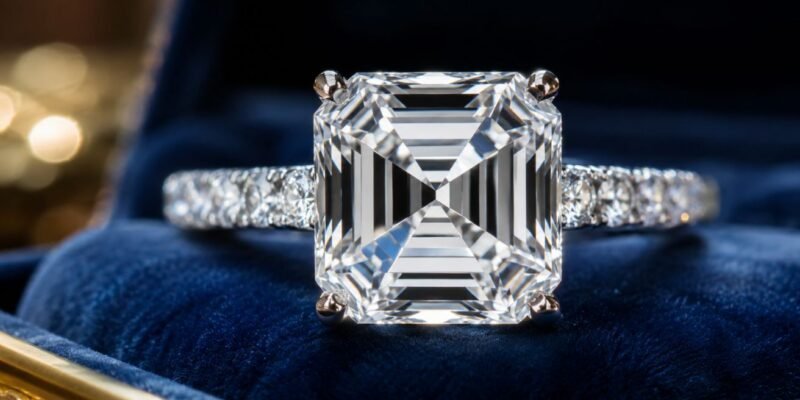
Choose an Asscher cut if you’re drawn to broad, clean flashes of light and that clear “step” pattern you can follow from the top. In normal daylight it often looks calmer than cuts with lots of tiny sparkles: you’ll see a bright, layered light pattern rather than constant glitter. If you’re sensitive to lots of small, fast twinkles, you’ll notice the difference immediately when you compare shapes side by side.
If you want to get a feel for whether this suits you, take a look at Asscher cut diamonds: you’ll quickly recognize that distinctive, layered pattern.
Start With Cut Quality, Not Carat
With an Asscher, cut quality determines most of your enjoyment. A well-cut stone makes those crisp, layered flashes return evenly as the diamond moves. That’s why the diamond can look “consistently beautiful” in everyday wear—before extra carat weight really adds anything to what you actually see.
From the top, look for a calm, centered pattern (often like an X or a windmill) and facet lines that look sharp and straight. In diffuse light (soft daylight), you’ll see broad, quiet bands of light; under spotlighting it clearly “switches on,” and the pattern moves with you as you tilt the stone. That’s exactly why we prefer to judge the cut pattern first and only then look at carat: this is what you’ll be seeing every day with every hand movement.
Clarity and Color: You’ll Spot What’s Inside the Stone Faster
An Asscher is honest. Because of the larger, more open facets, you’ll see what’s inside the stone more quickly. That’s useful, because you’ll immediately notice what bothers you—and what doesn’t. “Eye-clean” is a practical guideline for many people: at a normal viewing distance you don’t see distracting specks or haze, especially not in the center where your eye keeps returning.
Color shows more quickly too, especially in white metal or next to very white accent stones. So the diamond naturally reveals whether a tint still looks “white enough” to you in the setting you’re imagining. With clarity, the rule of thumb is often: you can fairly quickly tell with the naked eye if something bothers you, while higher clarity can increase the price without you always seeing that difference without a loupe. You’ll notice this most in metal and next to any side stones, because the overall look either clicks as one—or it doesn’t.
Settings and Wearing Style: Make the Corners Your Friend
The corners determine both the look and everyday practicality. A good setting takes care of that for you. Prongs on the corners or a subtle bezel edge help protect the corners better, which often makes the ring feel more practical for daily wear. If the setting fits well, an Asscher immediately looks neat and “architectural,” without feeling busy.
Styling-wise, a simple band next to it often works best:
- It keeps the lines clean
- The facet pattern naturally gets the attention
When You’re Better Off Choosing an Alternative
Are you mainly after lots of small, fast flashes? Then a round brilliant or another sparkle-heavy cut will naturally give you more of that “twinkle” look. And if you want a diamond to look as large as possible for its carat weight, a shape with more “spread” will show that effect more quickly than an Asscher. You’ll see that difference right away when you compare them side by side.
Want us to take a look with you at cut pattern, clarity, and a setting that fits your life? Our experts are happy to help you choose based on what you’ll actually see and notice every day.
Do Read: The Best Replica YSL Bags of 2025: Top Picks and Buying Guide